
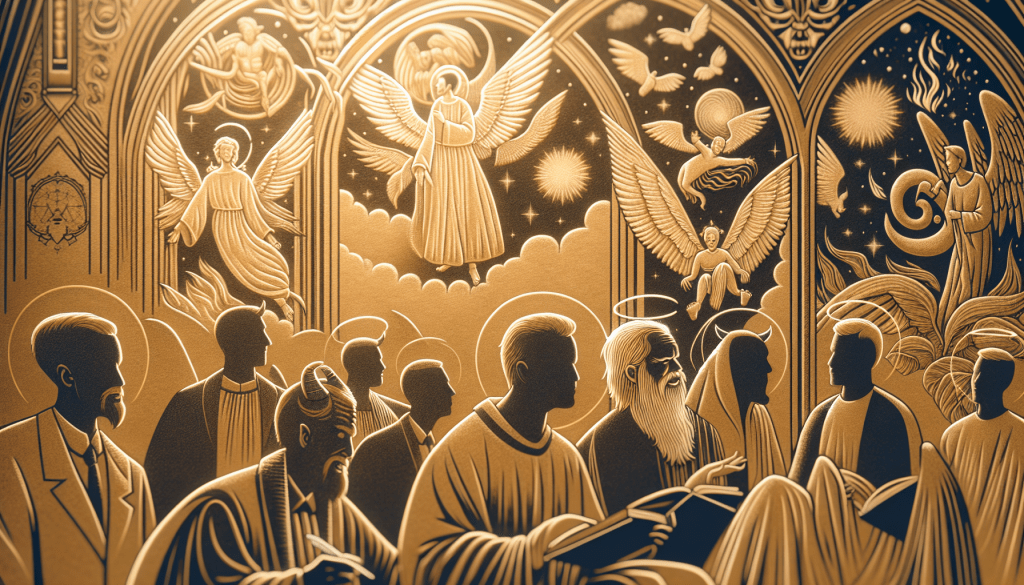
In the vast landscape of religious beliefs, few topics have captivated the human imagination over thousands of years as profoundly as angels and demons. These spiritual beings, woven into the fabric of many religious traditions, have intrigued scholars, theologians, and the general public. Their depictions in art, literature, and popular culture often blur the lines between myth and theology.
Today, I want to go deeper into the topic of angels and demons. These spiritual beings are integral to many religious traditions, including Catholicism, and through a more clear understanding a more clear direction can be made with how society integrates them.
Angels: Messengers of God
In Catholic theology, angels are pure spiritual beings created by God. They possess intellect and free will, but lack physical bodies. Their primary role is to serve as God’s messengers and agents, carrying out His divine will.
- Hierarchy of Angels:
- Angels are organized into a celestial hierarchy, traditionally divided into nine choirs: Seraphim, Cherubim, Thrones, Dominions, Virtues, Powers, Principalities, Archangels, and Angels. Each choir has specific roles and attributes.
- Archangels, such as Michael, Gabriel, and Raphael, are particularly significant in biblical narratives. Michael is depicted as a warrior leading God’s armies against the forces of evil, Gabriel as the messenger of important announcements, such as the Annunciation to Mary. Raphael the Archangel is a healer and guide in the world.
- Guardian Angels:
- Catholic belief holds that each person has a guardian angel assigned to protect and guide them throughout their life. This belief underscores the personal and intimate care that God extends to every individual.
- Biblical References:
- Angels appear throughout the Bible, from Genesis to Revelation. They deliver messages, protect individuals, and worship God, illustrating their varied and vital roles.
- Genesis 3:24: After Adam and Eve are expelled from the Garden of Eden, God places cherubim to guard the way to the Tree of Life.
Exodus 23:20-23: God promises to send an angel to guide and protect the Israelites on their journey to the Promised Land.
Isaiah 6:1-7: Isaiah’s vision of the Lord in the temple includes seraphim, who proclaim God’s holiness and cleanse Isaiah’s lips with a coal.
Daniel 6:22: An angel shuts the mouths of lions, protecting Daniel in the lion’s den.
Luke 1:11-20: The angel Gabriel appears to Zechariah to announce the birth of John the Baptist.
Luke 1:26-38: Gabriel also appears to Mary to announce that she will conceive and bear Jesus.
Matthew 1:20-21: An angel appears to Joseph in a dream, reassuring him about taking Mary as his wife.
Matthew 28:2-7: An angel rolls away the stone from Jesus’ tomb and announces His resurrection to the women.
Acts 12:6-11: An angel frees Peter from prison, guiding him past guards and through locked gates.
Revelation 5:11-12: A multitude of angels surround the throne of God, praising Him and the Lamb.
- Genesis 3:24: After Adam and Eve are expelled from the Garden of Eden, God places cherubim to guard the way to the Tree of Life.
- Angels appear throughout the Bible, from Genesis to Revelation. They deliver messages, protect individuals, and worship God, illustrating their varied and vital roles.
Demons: Fallen Angels
In Catholic theology, demons are angels who rebelled against God and were cast out of Heaven. Led by Lucifer, who became Satan, these fallen angels chose to oppose God’s will and now work to lead humanity away from Him.
- The Fall of Lucifer:
- Lucifer, originally a high-ranking angel, became prideful and sought to overstep God’s authority. His attempt resulted in his expulsion from Heaven along with his followers, who became demons. This narrative is rooted in passages like Isaiah 14:12-15 and Revelation 12:7-9.
- Demonic Influence:
- Demons seek to harm humans by tempting them to sin, spreading lies and deception, and causing spiritual and sometimes physical afflictions. Their ultimate goal is to draw people away from God and into a state of separation from His grace.
- Encounters with demons are recorded in the New Testament, where Jesus frequently exorcises them from possessed individuals, demonstrating His authority over evil.
- Exorcism:
- The Catholic Church practices exorcism, a rite intended to expel demons from individuals who are thought to be possessed. This ritual highlights the Church’s belief in Christ’s victory over evil and the authority of His name to overcome demonic forces.
Misconceptions About Angels and Demons
Why are angels and demons often misconstrued? Several factors contribute to these misconceptions:
- Popular Culture and Simplified Narratives:
- Movies, television shows, and books frequently depict angels and demons in ways that prioritize dramatic effect over doctrinal truth. Angels are often portrayed as benevolent but overly sentimental beings, while demons are depicted as purely malevolent monsters.
These portrayals simplify the complex theological roles and nature of these beings, leading to a superficial understanding.
- Movies, television shows, and books frequently depict angels and demons in ways that prioritize dramatic effect over doctrinal truth. Angels are often portrayed as benevolent but overly sentimental beings, while demons are depicted as purely malevolent monsters.
- Myth and Legend
- Over centuries, mythological elements have intertwined with religious beliefs, creating hybrid narratives that can distort original theological concepts. For instance, the image of a devil with horns and a pitchfork has more in common with pagan mythology than with biblical descriptions of Satan.
- Lack of Catechesis (Catholic Education)
- Misunderstandings also arise from a lack of proper religious education. Many people, even within the Catholic Church, may not receive comprehensive teaching on the nature and roles of angels and demons, leaving them to fill gaps with popular culture’s depictions.
Why Accurate Understanding Matters
Why should you care? Understanding angels and demons accurately is crucial for several reasons:
- Theological Accuracy:
- Accurate knowledge helps maintain the integrity of Catholic doctrine. Understanding angels as messengers of God’s love and demons as fallen beings opposed to His will grounds believers in the true teachings of their faith.
- Spiritual Formation
- Recognizing the roles of angels and demons in spiritual warfare can deepen one’s spiritual life. Awareness of guardian angels’ protective presence can bring comfort and encouragement, while understanding demonic temptations can strengthen one’s resolve to live a holy life.
- Cultural Literacy
- With accurate knowledge, individuals can critically engage with cultural depictions of these beings, distinguishing between entertainment and theological truth.
Fringe Topics: Misconceptions and Controversial Beliefs
When discussing angels and demons, it’s important to address some fringe topics and misconceptions that have emerged over time. These beliefs, often propagated by certain groups or individuals, can distort the theological understanding of these spiritual beings. Here are five topics that sometimes arise in discussions about angels and demons.
- The Media as an Instrument of Evil:
- Some believe that mainstream media is a tool of demonic influence, spreading falsehoods and moral corruption. This view holds that media content promotes values contrary to Christian teachings, such as materialism, violence, and promiscuity.
- Biblical Reference: Ephesians 6:12 reminds us that “our struggle is not against flesh and blood, but against the rulers, against the authorities, against the powers of this dark world and against the spiritual forces of evil in the heavenly realms.” While recognizing spiritual warfare, it’s essential to critically evaluate media content without attributing it solely to demonic forces.
- Homosexuality as Demonic:
- There are groups that claim homosexuality is a manifestation of demonic influence. They argue that same-sex attraction is unnatural and against God’s will, and therefore must be the work of demons.
- Biblical Reference: The Catholic Church references Leviticus 18:22 and Romans 1:26-27 regarding homosexual acts, but it also emphasizes compassion, as stated in the Catechism of the Catholic Church (CCC 2358), which urges respect and sensitivity. Simplifying this issue to demonic influence neglects the Church’s nuanced and pastoral approach.
- Conspiracy Theories About Government and Demonic Influence:
- Some conspiracy theories suggest that governments or high-ranking officials are under demonic control, working towards a new world order or other sinister objectives. These theories often tie into apocalyptic interpretations of current events.
- Biblical Reference: Romans 13:1-2 instructs, “Let everyone be subject to the governing authorities, for there is no authority except that which God has established.” While acknowledging the reality of spiritual warfare, the Church encourages believers to focus on personal holiness and social justice rather than indulging in speculative conspiracy theories.
- The Prosperity Gospel and Demonic Misrepresentation:
- The prosperity gospel, which claims that God rewards faith with wealth and health, sometimes labels poverty and illness as signs of demonic oppression or lack of faith. This view can lead to victim-blaming and an oversimplified understanding of suffering.
- Biblical Reference: 1 Timothy 6:10 warns, “For the love of money is a root of all kinds of evil.” The Catholic teaching emphasizes that suffering can have redemptive value (Colossians 1:24) and that material wealth is not a sign of God’s favor. Issues of suffering and poverty require compassion and social action, not simplistic attributions to demonic activity.
- New Age Spirituality and Angels:
- New Age beliefs often appropriate the concept of angels, presenting them as benign, non-denominational spiritual guides available to anyone regardless of religious belief. This view can dilute the traditional Christian understanding of angels as servants of God.
- Biblical Reference: Hebrews 1:14 describes angels as “ministering spirits sent to serve those who will inherit salvation.” Engaging with angels outside the context of their role in God’s plan can lead to misunderstandings and spiritual confusion. The Church warns against practices that deviate from authentic Christian spirituality.
Conclusion
Angels and demons are integral to Catholic theology, representing the ongoing spiritual battle between good and evil. While popular culture often distorts their true nature, a deeper exploration into Church teachings reveals a rich and complex understanding (which may be mentioned in future posts!). By seeking accurate information through scripture, tradition, and proper catechesis, believers can appreciate the profound roles these spiritual beings play in God’s plan.
If you’d like to share your thoughts on this subject then I encourage you to leave a comment for this post, you’ll definitely receive a counter-response.
As always I want to thank you for taking time to read A Look Around Blog. If you enjoyed what you read then I’d like to refer you down below to subscribe via email or to follow us on Instagram @alookaroundmedia to stay up to date with our missions.
Take care of yourself and somebody else,
-brandon.
 A Look Around Blog